Four services, one crew
Combining work saves money — replacing skylights during a re-roof is the single most efficient time to do it.
Roof Replacement
Full tear-off with quality shingles, proper underlayment, ice-and-water shield in valleys and eaves, and new flashing. Most GTA homes take 1–2 days. Old material hauled away, site magnet-swept for nails.
$5,000–$12,000+Roof Repairs
Missing shingles after a windstorm, leaks around chimneys and vents, damaged flashing, ice-dam damage. We repair what can be repaired and say plainly when a repair is throwing money at a roof that needs replacing.
Assessed on siteRoof Inspections
A clear written assessment of condition and remaining life — before buying a home, after a storm, for an insurance claim, or when your roof is past 15 years and you want to plan rather than react.
Written reportAttic Insulation
Under-insulated attics cause ice dams in winter and hot upstairs rooms in summer. Topping up is one of the highest-return upgrades a GTA home can make — and roof work is the most efficient time.
Ontario target R-60What the code actually requires on your roof
Most homeowners never see this, and a surprising number of quotes quietly leave it out. Here is what a compliant asphalt shingle roof in Ontario has to include — so you can check any quote you receive, including ours.
- 9.26.5Eave protection
- 9.19.1.2Attic ventilation
- CoTNo-permit list
- CPA10-day cancellation
Eave protection — the ice-and-water membrane
Under the Ontario Building Code (Subsection 9.26.5), eave protection is required on shingle roofs. It has to run from the roof edge at least 900 mm up the slope, and it has to reach at least 300 mm past the inner face of the exterior wall — whichever of those two is further up. On a house with a deep overhang, that means a single 900 mm course is not enough; the membrane has to be extended.
This is the layer that stops an ice dam from pushing water backwards under your shingles and into the wall. It is also the layer most commonly short-changed on a cheap quote, because it is buried and nobody sees it again for twenty years. The code allows several materials for it; self-sealing modified-bituminous membrane — what everyone calls ice-and-water shield — is the one we use.
The code does exempt some situations, including unheated garages, carports and porches, and roofs steeper than 1 in 1.5. If your quote skips eave protection, ask which exemption the contractor is relying on.
Attic ventilation — the number nobody checks
Article 9.19.1.2 requires unobstructed vent area of not less than 1/300 of the insulated ceiling area. On a roof pitched shallower than 1 in 6, or framed with roof joists rather than trusses, that tightens to 1/150. Vents also have to be distributed properly: at least 25% of the required opening at the top of the space and at least 25% at the bottom, so air can actually move through.
This matters more than it sounds. A roof with too little intake at the soffit will not exhaust no matter how many vents sit at the ridge. The result is a hot, damp attic that cooks shingles from underneath in July and builds ice dams in January. If you have had ice dams every winter on a roof that looks fine, ventilation and insulation are the first place to look — not the shingles.
Do you need a permit?
For a straight like-for-like shingle replacement — same material, no change to structure, pitch, or drainage — a building permit is generally not required in Toronto or the surrounding municipalities. That covers the large majority of the replacements we do.
A permit generally is required when the job changes something structural: replacing large areas of decking, or altering the roof slope. Switching to a materially heavier covering such as slate, clay tile, or some metal systems also triggers one, because the added dead load has to be assessed against the existing framing.
Skylights are more permissive than most homeowners are told. The City of Toronto's own no-permit list exempts installing a skylight in a house or small building of three storeys or fewer, provided the work removes no more than one rafter or joist — trusses excepted. Cut a truss, or cut through two or more rafters, and you need a permit. Almost nobody local writes this down, and it is why some quotes bundle in a permit cost that your job may not actually incur.
We check the framing before quoting and tell you which side of that line you fall on. We confirm the permit position with your municipality before work starts. A contractor who waves the question away is one to be careful with — unpermitted structural work can surface later during a home sale.
A replacement, layer by layer
Every quote we write covers all ten items. If you are comparing us against another quote, compare it line by line — the differences are usually in 02, 04 and 08.
Tear-off
Complete removal down to the deck. We do not shingle over an existing layer — it hides deck rot, voids most manufacturer warranties, and adds load your framing was not designed for.
Deck inspection
With the roof open we walk the whole deck and check for soft spots, delamination and gaps. Replacement sheathing is quoted per sheet at the price agreed up front, so a surprise cannot become a renegotiation while your roof is open.
Drip edge
Metal edge flashing at eaves and rakes, so water leaves the roof instead of wicking back into the fascia.
Eave protection
Self-sealing membrane at eaves to the code distance described above, plus full coverage in valleys and around every penetration. Extended where a deep overhang requires it.
Underlayment
Synthetic underlayment over the remaining field. It sheds water during the install and gives a secondary barrier for the life of the roof.
Starter course
A proper starter strip at eaves and rakes. This is what resists wind uplift at the edge, which is where nearly every blow-off begins.
Shingles
Laminate architectural shingles as standard, nailed to the manufacturer's pattern and nail count. Nailing pattern is the single biggest determinant of whether a wind warranty is honoured.
Flashing
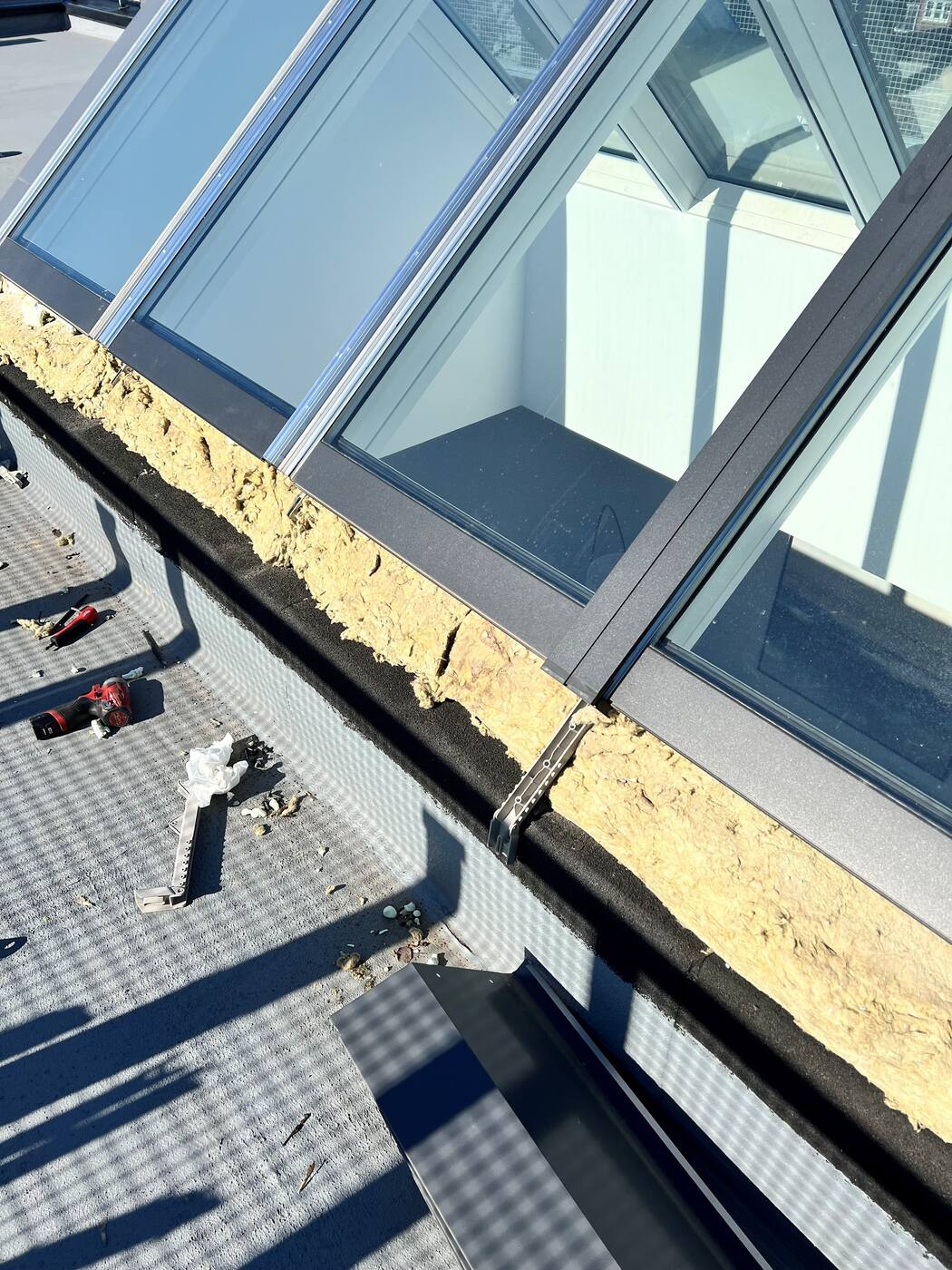
New flashing at chimneys, walls, vents and skylights. Reusing old flashing is a false economy — flashing is where roofs leak, not the middle of the field.
Ventilation
Intake and exhaust checked against the 1/300 (or 1/150) requirement and corrected if the existing roof was short. Most GTA re-roofs we open are short at the soffit.
Cleanup
All debris hauled away, grounds magnet-swept for nails, gutters cleared of granules and offcuts. Same day.
Which one do you actually need?
We will tell you when a repair is the right answer. A roof we replace five years early is a customer we lose for the next twenty.
Your rights when you sign at the kitchen table
If you sign a roofing contract worth $50 or more in your home, Ontario's Consumer Protection Act treats it as a direct agreement. You get 10 calendar days to cancel for any reason, with no cancellation fee, starting from when you receive your copy of the signed contract.
If the contractor starts work inside those 10 days and you then cancel, you do owe for work performed and materials used — which is exactly why high-pressure crews push to start immediately. A contractor confident in their price is happy to wait out your cooling-off period.
Two more things worth doing before anyone climbs up:
- Ask for a WSIB clearance certificate. If an uninsured worker is hurt on your property, you can be exposed. Ours is available on request, every time.
- Be wary of a large up-front deposit. Materials are ordered against the job, not against your cash.
When to call a roofer
- Shingles curling, cracking, or missing — especially after a windstorm.
- Water stains on ceilings or around skylights and chimneys.
- Granules collecting in gutters — shingles shedding their protective layer.
- Ice dams every winter — usually an insulation and ventilation problem, not just a roof problem.
- Roof over 15–20 years old — get ahead of it with an inspection before it becomes an emergency.
Storm damage & insurance claims
GTA windstorms and hail can damage a roof in minutes. We document damage with photos, provide the written assessment your insurer needs, and complete repairs to code. Call us before the next rain makes it worse.
Get a damage assessment →See what a new roof costs in two minutes
Type your address, trace your roof outline, pick your shingle. The tool measures the real roof area from satellite imagery and shows a ballpark range on the spot — no measuring and no sales call.
Customize your roof
Roofing FAQ
How much does a roof replacement cost in the GTA?
Most residential replacements run $5,000–$12,000+ depending on roof size, pitch, layers to remove, and material choice. You get a firm written quote after we measure — the price we quote is the price you pay.
How long does a roof replacement take?
Most GTA homes are done in 1–2 days, weather permitting. We don't open more roof than we can close the same day.
Repair or replace — how do I decide?
Rule of thumb: localized damage on a roof under 15 years old → repair. Widespread wear, multiple leaks, or a roof past its shingle warranty → replacement is usually cheaper over 5 years than repeated repairs. Our inspection gives you the honest answer either way.
Do I need a building permit to replace my roof?
For a like-for-like shingle replacement with no change to structure, pitch or drainage, a permit is generally not required in Toronto or the surrounding municipalities. A permit is generally required if the work is structural — replacing large areas of decking, changing the slope, or switching to a much heavier covering like slate or tile. Skylights are more permissive than most people expect: the City of Toronto exempts installing a skylight in a house or small building of three storeys or fewer where no more than one rafter or joist is removed, trusses excepted. We check the framing and confirm the position with your municipality before work starts.
How far up the roof does ice-and-water shield have to go?
Ontario Building Code Subsection 9.26.5 requires eave protection to extend at least 900 mm up the slope from the roof edge, and to reach at least 300 mm inside the inner face of the exterior wall — whichever is further. On homes with deep overhangs a single course is not enough and the membrane has to be extended. It is one of the most commonly short-changed items on a cheap quote.
How much attic ventilation does my roof need?
Article 9.19.1.2 of the Ontario Building Code requires unobstructed vent area of at least 1/300 of the insulated ceiling area, tightening to 1/150 where the slope is under 1 in 6 or the roof is framed with joists. At least 25% of the opening must be at the top of the space and at least 25% at the bottom. Most GTA re-roofs we open are short on intake at the soffit.
Can I cancel a roofing contract after I sign it?
If you signed in your home for $50 or more, Ontario's Consumer Protection Act treats it as a direct agreement and you have 10 calendar days to cancel for any reason with no fee, starting when you receive your copy of the signed contract. If work has already begun in that window you will owe for labour performed and materials used.
Can you shingle over my existing roof?
We don't. Layering hides deck rot you would otherwise catch, adds load the framing wasn't designed for, and voids most manufacturer warranties. Every replacement we do is a full tear-off to the deck.
Are you insured?
Yes — liability insurance, WSIB coverage, and working-at-heights certification. Ask any roofer for a WSIB clearance certificate before they start; if an uninsured worker is injured on your property, you can be exposed. Ours is available on request.
Roof replacement across the GTA
Roof age profile and permit rules vary by municipality. Pick your area for the specifics.
City of Toronto
Four very different housing stocks. Old-city Toronto for Victorian and Edwardian semis, narrow lots and low-slope rear additions. Scarborough for post-war bungalows and the wind exposure near the bluffs. North York for Willowdale rebuilds and the near-flat Don Mills modernist roofs. Etobicoke for The Kingsway, Long Branch and multi-pitch additions.
Mississauga & Brampton
Mississauga is a dozen housing markets stacked together — Port Credit century homes through to Churchill Meadows new build, with a lot of 1980s acrylic bubble skylights now well past sealed-unit life. Brampton is dominated by 1990s and 2000s subdivision stock now hitting its first replacement cycle.
Vaughan, Richmond Hill & Markham
Vaughan and Richmond Hill are largely engineered-truss subdivision builds, which changes what is possible when cutting an opening. Markham adds Unionville's heritage constraints alongside the Cornell and Berczy subdivisions.
Oakville
Oakville spans Old Oakville's heritage properties, the 1970s and 80s Glen Abbey and River Oaks stock, and newer north Oakville builds — three different conversations about the same roof.
Get an honest assessment
Free quotes and straight answers, anywhere in the GTA.