
Prepare your GTA roof for winter: a fall checklist to avoid ice dams and leaks
October and November are the useful window. The leaves are coming down, a hard freeze has not locked the gutters yet, and you can still see the roof. A short look now is what keeps a January drip — or a ridge of ice along the eave — from being the first time anyone notices a problem.
Do the checks from the ground and from the attic hatch. Leave the roof itself to someone set up to be on it.
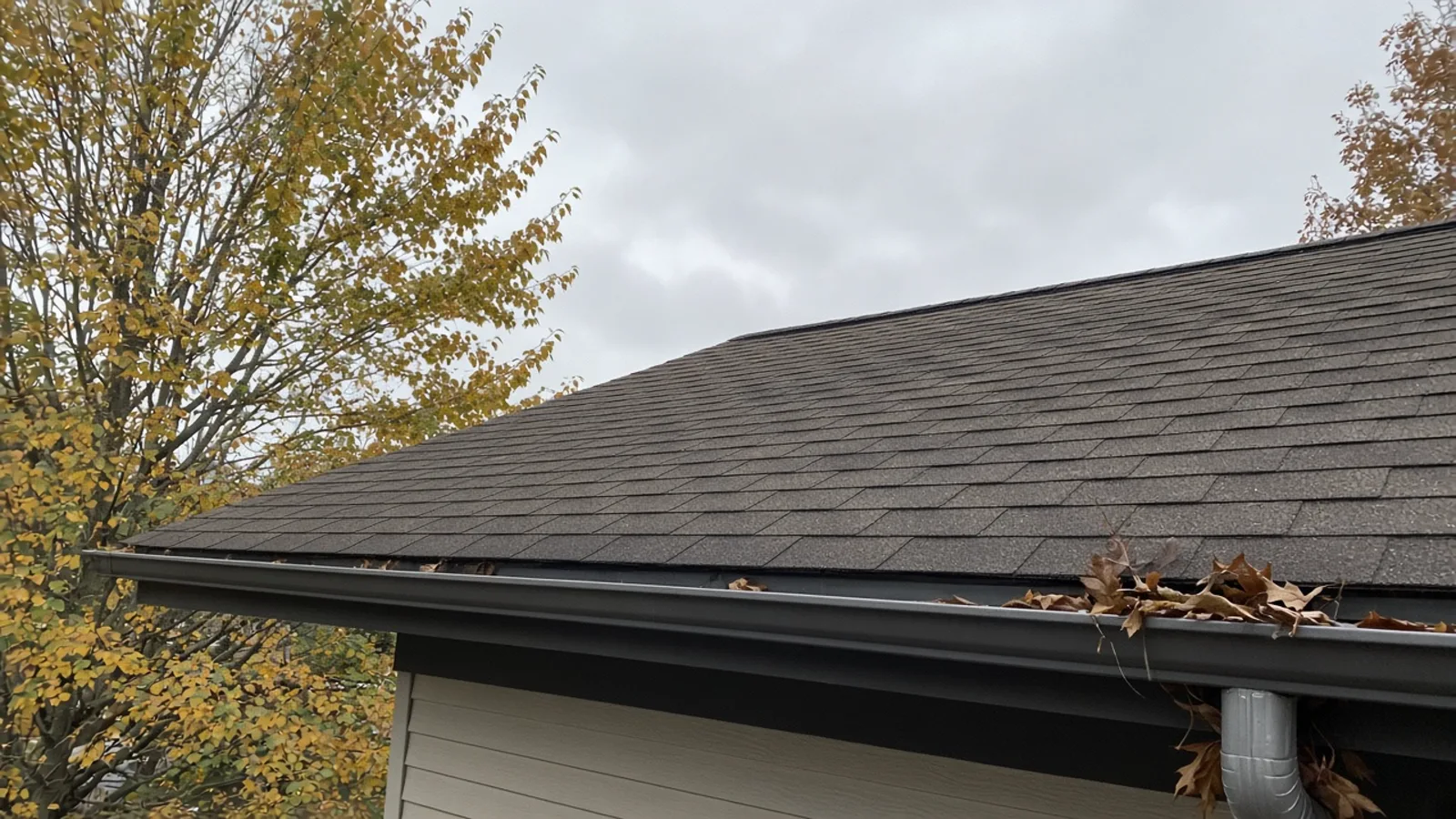
Clear the gutters and downspouts before the leaves peak
A gutter full of leaves does not just overflow onto the lawn. Water sits against the fascia, finds the gap behind the trough, and runs into the soffit or down the wall. Once that water freezes, the next melt has nowhere to go except under the shingles.
On a GTA lot the maples and oaks do not drop all at once. Plan two passes: one while the leaves are heavy, and one after the trees are mostly bare, before a freeze turns the mess solid. The photo above is the in-between — a slope that still looks tidy, and an eavestrough that is already full.
- The trough, including the corners. A clear middle and a packed corner still floods. Check the run just uphill of each downspout outlet, which is where leaves stop.
- Each downspout, top to bottom. If you can reach the bottom elbow from the ground, take it off and look. Water should come out the end of the spout, not spill over the front lip of the gutter.
- Where the spout discharges. It should land away from the foundation, not into a bed tight against the wall or a spout buried in soil.
- The fascia and soffit behind a gutter that has been overflowing. Staining, peeling paint, or soft wood means water has already been getting past.
If water is already coming through a ceiling, stop this checklist and follow what to do when a roof is leaking. The first hour is about the ceiling and the photos, not about finishing the gutters.
Spot missing shingles and worn flashing
From the sidewalk, look along each slope for shingles that are gone, cracked, or sitting up at the edge. One tab missing after a windstorm is usually a repair. Cracking or curling spread across a whole slope is a different job. That roof is ageing, and patching it piece by piece rarely holds. If that is what you are seeing, read the signs a roof needs replacing and what a replacement costs in the GTA.
A cedar shake roof is a different surface. Grey is normal on cedar, and the wear shows up as splits, cups, and a tired valley. That check is its own page: what to look for on cedar shakes before winter.
Flashing is where winter leaks tend to start, and it is easy to miss because it sits in the shadow of a chimney, a sidewall, a valley, a plumbing vent, or a skylight. From the ground, look for metal that is rusted, lifted at a corner, or smeared with roofing tar. Tar over flashing is a patch, not a seal, and freeze–thaw opens it back up.
If what you find looks like storm damage, shingles torn off, a branch through the deck or hail marks, photograph it before anyone tidies the slope, then read how Ontario storm-damage claims work. Wear and sudden damage are not the same claim, and the photos are what the difference hangs on.
Check attic ventilation so warm air does not build ice dams
An ice dam is meltwater that refreezes at the cold eave. The melt usually starts on the roof deck, not in the sky. Warm indoor air leaks into the attic, the deck above that air gets warm enough to melt the snow sitting on it, and the water runs down to the overhang, past the heated wall, where the shingles are cold, and freezes. The dam grows. The next melt backs up behind it and under the shingles.
You can see a lot of this from the hatch, without walking out onto the ceiling joists:
- Intake at the eaves. You should see light, or feel outside air, at the soffits. Insulation piled tight against the eaves blocks that intake, and a ridge vent cannot pull air that never gets in.
- A path out at the top. A ridge vent, roof vents, or gable vents that are not buried, painted shut, or blocked by stored boxes.
- Warm, wet air coming up. The attic hatch itself, a bathroom fan that dumps into the attic instead of outdoors, and gaps around pot lights. That air is what warms the deck.
- Frost on nails or on the underside of the sheathing once the weather is cold. Moisture is condensing because the air in the attic is not leaving.
The Ontario Building Code sets how much vent area a roof needs and how that area has to be split between the top and the bottom of the attic. The distances, and how to check them on a quote, are in what the code requires on your roof. How deep the insulation should sit is a separate question. How much attic insulation you need in the GTA covers it. Topping up insulation while the soffits stay blocked does not fix an ice dam.
If the same eave grows a dam every January, chipping the ice off is not the repair. The airflow and the insulation are.
Seal skylights ahead of freeze–thaw
Skylights rarely fail through the glass. They leak at the flashing and at the seals in the frame, and freeze–thaw is what opens a gap that looked fine in September.
From inside, look at the shaft and the drywall around the unit. A tea-coloured stain, soft wood, or paint that has bubbled is water that has already been through. From the ground, look at the flashing: it should sit flat, with no lifted corner on the uphill side and no pile of leaves or granules holding water against the curb. Debris on the upslope side of a skylight is the same problem as a packed gutter, just smaller.
If the unit opens, close it and latch it before the first hard freeze. A venting skylight left on a crack is a leak and a hole in the attic air seal. Whether an opening unit was the right choice for that room is a different question. We covered venting versus fixed skylights on its own. For winter, the job is simply that it is shut.
Do not smear caulk or roofing tar over the frame to get through the season. That traps water and makes the next flashing job harder. If the frame is cracked, the sash will not latch, or the shaft is already stained, it needs a roofer, not a tube of sealant.
A sun tunnel has the same roof-side problem: a dome and a flashing kit that have to shed water before anything else matters. The ceiling diffuser can look perfect while the curb above it is the leak. If you are pricing a replacement rather than a winter check, what a skylight costs in Toronto is the page with the ranges, and skylight installation is the scope of the work. Adding a new unit is a different job from that check. Skylight installation in winter is still a same-day cut, frame and seal.
The order that fits a weekend
- Gutters and downspouts, then a second pass once the trees are bare.
- A ground-level look at shingles and flashing. Photograph anything lifted, missing, or tarred.
- A look from the attic hatch: soffit intake, a path out at the top, and whether the hatch itself seals.
- Skylights and sun tunnels: stains inside, flashing outside, venting units closed and latched.
- If water is already inside the house, switch to the emergency steps and call.
| What you see | What to do before winter |
|---|---|
| Leaves in the trough, downspouts slow | Clear them, and again after the trees are bare |
| One or two missing shingles | A repair, before snow hides the spot |
| Curling across a slope, or flashing that is tarred and tired | Read the replacement signs, and get it assessed |
| Ice at the same eave every winter, or soffits blocked by insulation | Ventilation and insulation, not another January with a roof rake |
| A stain around a skylight, or a venting unit that will not latch | Reflash or replace before freeze–thaw works the gap wider |
| Water coming through a ceiling now | Emergency steps, then a roofer |
Rules of thumb from GTA roofs we see in the fall. A site visit tells you what the job actually is.
When to call
Call before the snow if water is already inside, the same eave ices up every winter, flashing is lifted, a skylight shaft is stained, or you are no longer sure whether you are looking at a repair or a roof that is finished. Well Roofing is based at 17 Peterlee Avenue in Etobicoke, and we come to the house — Toronto, Mississauga, Vaughan, and the rest of the GTA.
Book a free assessment and we will tell you what the fall check turned up, including when it can wait until spring. If you are pricing a full replacement rather than a winter repair, the roof customizer measures the roof from satellite imagery before anyone drives over. Or call (416) 999-9706.